SDF à Maurice : « Mo rest lor simin ek mo trace mo...
07 October 2026
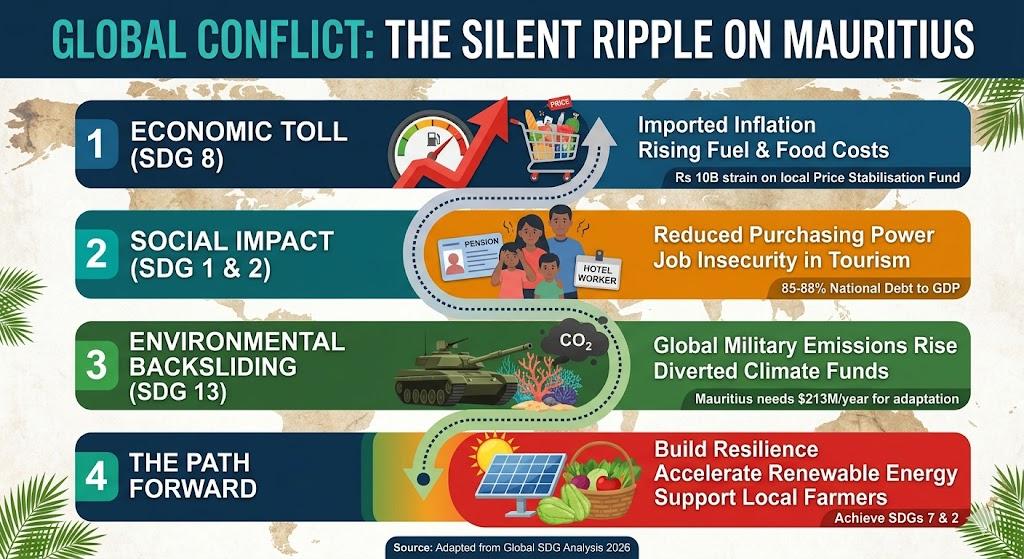
Alors que le tonnerre des conflits semble lointain par rapport à nos lagons turquoise, la réalité de 2026 prouve que dans une économie mondialisée, il n'y a pas de spectateurs. Pour Maurice, Petit État Insulaire en Développement (PEID), l'instabilité géopolitique actuelle n'est pas qu'un titre de presse : c'est un poids économique, social et environnemental porté par nos communautés locales.
Voici une analyse de la situation actuelle, soulignant comment la guerre au Moyen-Orient ébranle les fondations de notre île.
1. Le Fardeau Économique : Le Coût de la Vie Étrangle les Ménages
Le principal "vecteur de transmission" de la guerre est l'inflation importée. Maurice important près de 80 % de sa nourriture et 100 % de ses combustibles fossiles, les chocs de prix frappent instantanément nos bazars et nos stations-service.
Crise de l'Énergie : En mars 2026, les prix du pétrole frôlent les $100 le baril. Pour le Mauricien moyen, cela signifie des tickets de bus plus chers et des factures d'électricité qui grimpent. Avec des réserves nationales estimées à seulement 21 jours, le rationnement énergétique menace directement la productivité de nos petits entrepreneurs.
Le Prix de l'Assiette : La perturbation des chaînes d'approvisionnement en engrais a fait bondir le prix des légumes locaux de 3 % en un mois. La sécurité alimentaire du pays est en péril, mettant à rude épreuve le Fonds de Stabilisation des Prix.
Impact ODD : Cette situation sape directement l'ODD 8 (Travail décent et croissance économique) et l'ODD 1 (Pas de pauvreté), car le pouvoir d'achat des foyers modestes s'évapore sous la chaleur des coûts croissants.
2. Impact Social : Une Vulnérabilité Accrue
La guerre agit comme un "multiplicateur de menaces" pour les inégalités sociales.
Tourisme et Moyens de Subsistance : Les prévisions de 1,45 million de touristes pour 2026 vacillent. À cause de la hausse des billets d'avion (jusqu'à 45 % globalement) et de l'instabilité régionale, les arrivées chutent. Pour les milliers de Mauriciens travaillant dans les hôtels ou comme chauffeurs de taxi, cela se traduit par une insécurité de l'emploi immédiate.
Le Poids de la Dette : Notre dette nationale stagne entre 85 % et 88 % du PIB. Chaque roupie dépensée pour subventionner le carburant afin d'éviter l'agitation sociale est une roupie détournée de la santé et de l'éducation.
Impact ODD : Ce recul affecte l'ODD 2 (Faim "zéro") et l'ODD 10 (Inégalités réduites), creusant le fossé entre les nantis et les classes populaires.
3. Perspective Environnementale : Un Revers pour le Climat
L'environnement est souvent la victime oubliée des conflits armés. La guerre moderne est une entreprise à forte intensité de carbone qui sabote notre résilience locale.
L'Empreinte Carbone Militaire : Les armées mondiales sont responsables d'environ 5,5 % des émissions mondiales de gaz à effet de serre. Si les armées étaient un pays, elles seraient le quatrième plus grand émetteur au monde.
Détournement des Investissements Verts : Maurice a besoin de $213 millions par an pour ses objectifs d'adaptation climatique. Cependant, les fonds mondiaux sont siphonnés par les budgets de guerre au détriment de l'ODD 13 (Action climatique).
Dommages Écologiques : Le conflit près des points de passage maritimes comme le détroit d'Ormuz augmente les risques de marées noires. Une pollution majeure dans l'océan Indien dévasterait notre biodiversité et, par extension, notre "Économie Bleue".
L'Impact Réel sur les Mauriciens en 2026
La réalité est brutale : à Maurice, la guerre au Moyen-Orient ne se regarde pas à la télévision, elle se ressent dans le portefeuille vide de la ménagère au marché de Port-Louis, dans l'angoisse du planteur qui ne peut plus payer ses engrais, et dans l'incertitude du travailleur du tourisme qui voit les réservations s'annuler. Nos racines sociales sont sous pression, et notre résilience est testée comme jamais auparavant.
La Voie à Suivre
La leçon de 2026 est claire : la résilience n'est plus une option, c'est une nécessité de survie. Pour protéger notre population, Maurice doit accélérer sa transition vers les énergies renouvelables (ODD 7) et renforcer ses systèmes alimentaires locaux (ODD 2). En réduisant notre dépendance aux chaînes énergétiques et alimentaires volatiles du "Vieux Monde", nous pourrons isoler notre île des chocs d'un monde en guerre.