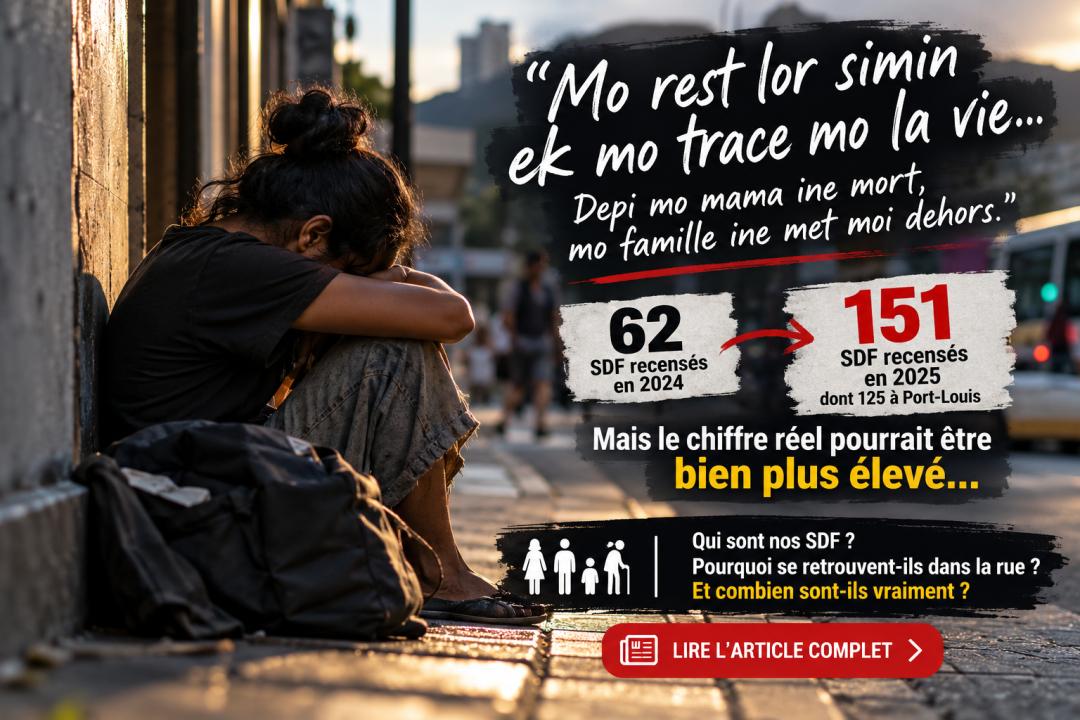
SDF à Maurice : « Mo rest lor simin ek mo trace mo...
07 October 2026

It is a sentence we often use to awaken empathy. Yet for any parent, it is also one of the most frightening thoughts imaginable.
Imagine the daughter you raised with love and hope — the one whose education you encouraged, whose future you quietly dreamed about, whose laughter filled your home. Now imagine her name suddenly appearing in a tragic headline.
But there is another, more difficult question that society rarely asks:
What if the child we raised with love is the one who becomes the perpetrator?
When we speak about feminicide in Mauritius, we are not only speaking about crimes. We are also invited to reflect on the deeper questions surrounding relationships, upbringing, and the values we pass on to the next generation.
This reflection is not about blaming society. It is about asking whether, at times, we might unknowingly overlook the warning signs that lead to such tragedies.
Statistics may inform us, but names remind us that these were real lives.
Mauritius has mourned women such as Dikshita , Mahima , Fadila, Swaleha , Sheena, Natasha , and Dana.
They were daughters, sisters, mothers, colleagues, and friends. Above all, they were human beings — Mauritian women like us, entitled to the same right to live, to be safe, and to be respected
Their stories shook the nation because they revealed a painful reality: violence often grows silently within relationships before it becomes visible to the world.
When a woman loses her life in such circumstances, it is not only a family that suffers. The entire nation pauses — asking how such tragedies could happen among us.
After these tragedies, we sometimes hear explanations that attempt to soften the horror:
"He loved her too much."
"She trusted him too much."
But love should never become fear.
True love protects.
True love respects.
True love never destroys.
Yet many women remain in relationships hoping for change. They believe promises, patience, and the hope that tomorrow will be different.
Families may sometimes encourage endurance for the sake of stability or reputation. But patience should never mean tolerating humiliation or violence.
Love cannot survive where dignity disappears.
To every young woman in Mauritius:
Your worth is not measured by your relationship status.
If there are early signs of control, humiliation, or intimidation, do not dismiss them. Seeking help or choosing to step away is not weakness — it is courage.
Your life matters.
Your safety matters.
Your peace matters.
Protecting yourself and your children is an act of strength, not selfishness.
Every tragedy invites reflection.
Perhaps the most important question is not simply “Who is to blame?” but rather:
What can we learn?
Are we teaching young boys that strength means respect rather than domination?
Are we encouraging healthy emotional expression instead of silence or anger?
Are we listening when someone quietly asks for help?
Families, schools, faith communities, and institutions all play a role in shaping the values of future generations.
When respect, empathy, and equality are taught early, they become powerful protections later in life.
There is another challenge we must address: silence.
Too often, signs of violence are dismissed as “private matters.” But when a life is at risk, silence protects no one.
Neighbors, relatives, and friends sometimes see the warning signs long before authorities do.
A caring conversation, an offer of help, or a willingness to speak up may make the difference between tragedy and safety.
Mauritius is a country deeply rooted in faith and family values.
In all religions and traditions, life is sacred because every human being is created in the image of God. Violence against another person is therefore not only a crime against the law — it is also a wound inflicted on our shared humanity.
Perhaps the most important step forward is collective reflection.
Not to condemn, but to learn.
Not to accuse, but to prevent.
Because behind every name we remember is a life that deserved safety, dignity, and the chance to grow old.
And perhaps the question we must carry forward as a nation is this:
What kind of society do we want our children to inherit — and what values must we nurture today to ensure that every daughter, sister, and mother can live without fear?
Only when we answer that question together can we truly say that we have honored the lives we lost.